
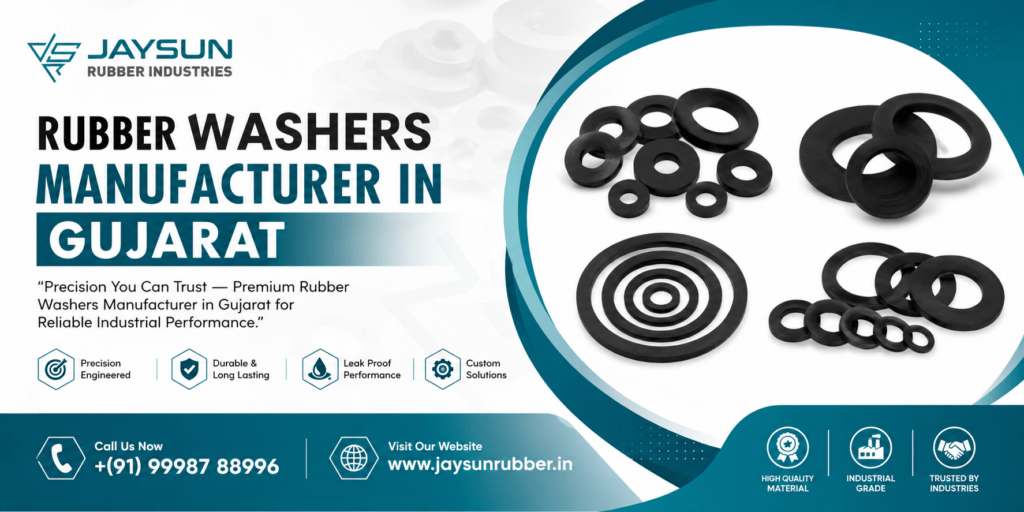
Rubber Washers Manufacturer in Gujarat
Introduction
Founded in 2012, Jaysun Rubber Industries is a trusted manufacturer and supplier of premium-quality industrial rubber components designed to meet the demanding requirements of various industries. With over a decade of manufacturing expertise, advanced production technology, precision moulding capabilities, and stringent quality control processes, we produce durable, high-performance rubber products that deliver excellent sealing, vibration control, and long-lasting reliability across diverse industrial applications.
Rubber washers are small but highly important components used in many industrial, engineering, automotive, plumbing, electrical, and manufacturing applications. They help create a secure seal between two surfaces, reduce vibration, prevent leakage, and protect connected parts from damage. Choosing a reliable Rubber Washers Manufacturer in Gujarat is important for businesses that need consistent quality, accurate dimensions, and durable rubber products.
Jaysun Rubber Industries provides trustworthy rubber washers made for various industrial needs if you’re searching for a rubber washer manufacturer in Gujarat. The company offers useful sealing solutions for a variety of applications with an emphasis on quality, precise measurements, and appropriate rubber materials. Unlike ordinary metal washers, rubber washers also provide sealing and cushioning properties. Depending on the rubber compound selected, they can offer resistance against water, oils, chemicals, heat, weathering, and mechanical stress. We are the best Rubber Washers Supplier.
What Are Rubber Washers
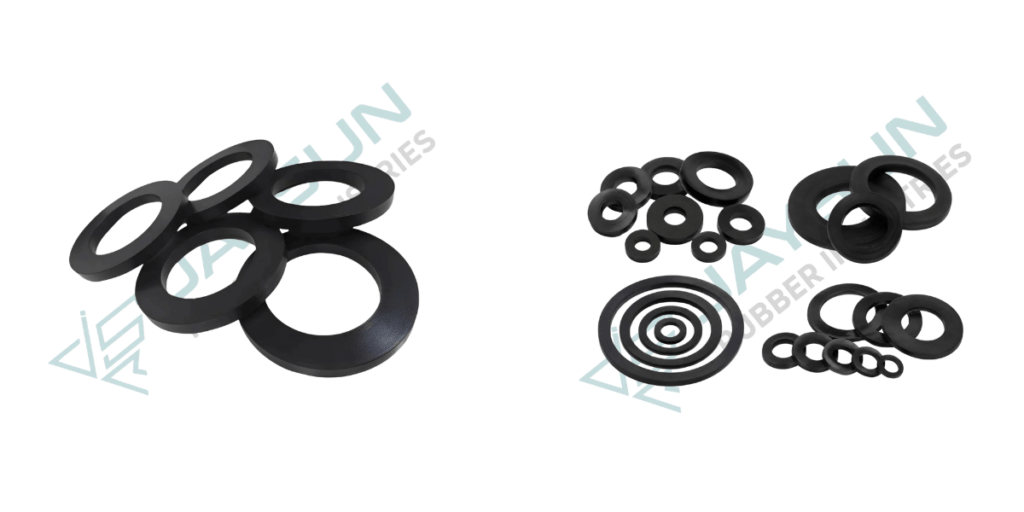
Rubber washers are circular sealing components with a hole in the centre. They are generally placed between two surfaces, such as a bolt and a nut, flange and pipe, or other connected components. Unlike metal washers, rubber washers provide flexibility and sealing properties along with mechanical support.
Unlike ordinary metal washers, rubber washers can provide sealing and cushioning properties. They can help prevent water, air, oil, dust, and other substances from passing through a joint. Their flexibility also allows them to compensate for minor surface irregularities. Because of these properties, rubber washers are widely used in machinery, automobiles, electrical equipment, plumbing systems, pumps, valves, and various industrial assemblies. We are the best Rubber Washers Exporter.
Why Choose Jaysun Rubber Industries
1. High-Quality Rubber Materials
- A professional manufacturer can offer rubber washers in different materials according to the application. Common options include Nitrile (NBR), EPDM, Silicone, Neoprene, Natural Rubber, and Viton. Each material provides different levels of resistance to oils, water, chemicals, temperature, weather, and environmental exposure. For example, NBR is commonly selected where oil and fuel resistance is required, while EPDM is suitable for water, weather, UV, and outdoor applications. Silicone is useful for applications requiring a wider temperature range.
2. Precision Manufacturing
- Dimensional accuracy is essential for rubber washers. Incorrect inner diameter, outer diameter, or thickness can affect installation and sealing performance. Experienced manufacturers use suitable moulding, cutting, and finishing processes to maintain consistent dimensions throughout production batches. Precision manufacturing helps provide a proper fit and reduces problems during assembly.
3. Accurate Dimensions and Consistent Quality
- Dimensional accuracy is essential when rubber washers are installed in assemblies. Variations in inner diameter, outer diameter, or thickness can affect sealing performance and assembly fit. An experienced manufacturer uses controlled production and inspection processes to maintain consistency across batches. Precision manufacturing is particularly important for applications involving hydraulic systems, machinery, automotive assemblies, and industrial sealing.
4. Cost-Effective Bulk Manufacturing
- For industrial buyers, purchasing rubber washers directly from a manufacturer can provide advantages in terms of production planning and bulk supply. Manufacturers can handle large-volume requirements while also supporting customised specifications. This is especially useful for OEMs and distributors that require thousands or large quantities of washers regularly.
5. Multiple Manufacturing Options
- Depending on the design, quantity, and application, rubber washers may be manufactured using processes such as moulding or lathe cutting. Moulded washers can be suitable for high-volume production and precision requirements, while lathe-cut washers can be economical for certain flat washer designs and lower-volume requirements. A capable manufacturer can recommend the appropriate manufacturing method based on the product specification and production quantity.
6. Reliable Sealing Performance
- One of the primary purposes of a rubber washer is to provide an effective sealing interface between mating surfaces. The flexibility of rubber allows the washer to conform to surfaces and help minimize the possibility of leakage. Depending on the selected compound, rubber washers can be used for water, oils, fuels, hydraulic fluids, chemicals, and other service environments. Material selection should always be based on the actual operating conditions.
7. Vibration and Shock Absorption
- Rubber has natural elastic properties that make it useful for absorbing vibration and reducing mechanical shock. Rubber washers can therefore help isolate components and reduce noise and mechanical stress in suitable applications. This benefit makes them useful in machinery, automotive assemblies, electrical equipment, construction equipment, and other applications where vibration control is important.
8. Wide Range of Sizes and Hardness
- A professional Rubber Washers Manufacturer in Gujarat can provide different sizes and hardness levels to match application requirements. Depending on the manufacturer and compound, washers can be supplied in different thicknesses, diameters, and Shore A hardness values. The correct hardness is important because the washer must provide the required flexibility, compression, sealing, and load-bearing characteristics.
9. Better Support for OEM Requirements
- OEMs often need rubber washers manufactured according to specific drawings rather than standard catalogue dimensions. Working directly with a manufacturer can simplify communication regarding technical drawings, samples, material selection, tolerances, tooling, and production requirements. A manufacturer with technical expertise can also help identify an appropriate rubber compound according to temperature, pressure, chemical exposure, and environmental conditions.
10. Strict Quality Control
- Quality inspection plays an important role in rubber washer manufacturing. A professional manufacturer should maintain checks for important parameters such as dimensions, hardness, surface condition, material consistency, and overall workmanship. Depending on the application, customers may also require specific testing or documentation. Consistent quality control helps reduce rejection rates and improves reliability in the final assembly.
11. Faster and Reliable Supply
- Selecting a manufacturer located in Gujarat can be advantageous for businesses sourcing industrial rubber components from within India. Established manufacturers can support regular production requirements, customised orders, and bulk quantities. Reliable delivery is particularly important for industries where rubber washers are used as essential assembly or sealing components.
Applications of Rubber Washers
1. Automotive Industry
- Rubber washers are widely used in automotive components and assemblies for sealing, cushioning, vibration isolation, and protection. They can be installed around bolts, screws, fittings, pipes, and other fastening points to prevent fluid leakage and reduce vibration. They are commonly used in fuel systems, cooling systems, hydraulic components, engine assemblies, pumps, compressors, and other vehicle components. NBR rubber washers are particularly useful in applications where resistance to oils, fuels, and grease is required.
2. Electrical and Electronics Industry
- Electrical equipment requires insulation and protection against vibration, moisture, and mechanical stress. Rubber washers can act as insulating barriers between metal components and help protect electrical assemblies from unwanted contact. They are used in electrical panels, switchgear, transformers, motors, control cabinets, wiring assemblies, and other electrical equipment. Silicone and EPDM washers can be selected where temperature, weather, or environmental resistance is important.
3. Plumbing Applications
- Rubber washers are essential in plumbing fittings because they help create a tight seal between connected components. They can prevent water leakage from taps, pipe fittings, hose connections, valves, shower fittings, and other plumbing assemblies. Their flexibility allows the washer to compensate for small surface irregularities and maintain contact between mating surfaces. EPDM is commonly selected for water-related applications because of its resistance to moisture and weathering.
4. Hydraulic and Pneumatic Systems
- Hydraulic and pneumatic equipment operates under pressure, making effective sealing extremely important. Rubber washers can be used in fittings, connections, valves, pumps, cylinders, and other components where leakage prevention is required. NBR washers are suitable for many oil and hydraulic-fluid applications, while FKM/Viton materials may be selected for higher chemical and temperature resistance. The correct material should always be selected according to the actual operating conditions.
5. Industrial Machinery
- Industrial machinery contains numerous bolted joints, housings, fittings, covers, pumps, and moving assemblies. Rubber washers can help prevent leakage while also reducing vibration and mechanical stress. They are used in manufacturing machinery, compressors, pumps, motors, gearboxes, valves, machine tools, and engineering equipment. Their cushioning properties can help reduce noise and vibration between connected components.
6. Pumps and Valves
- Pumps and valves often handle water, oils, chemicals, compressed air, and other fluids. Rubber washers provide sealing around fasteners and connections to reduce the possibility of fluid leakage. Different rubber compounds can be selected according to the fluid being handled. NBR is commonly used where oil resistance is required, while EPDM is suitable for many water and weather-exposed applications. FKM can be considered for demanding chemical and temperature conditions.
7. Oil and Gas Equipment
- Oil and gas equipment requires sealing components capable of handling demanding operating environments. Rubber washers can be used in fittings, valves, pipelines, pumps, instrumentation, and mechanical assemblies. For oil-based fluids, NBR is often considered because of its oil and fuel resistance. For more demanding chemical or high-temperature conditions, other elastomers such as FKM may be selected based on compatibility requirements.
8. Construction Industry
- Rubber washers are used in construction equipment, roofing systems, fasteners, pipe connections, outdoor fittings, and structural assemblies. They can provide sealing and cushioning between fastened components. In outdoor applications, weather-resistant materials such as EPDM and Neoprene can provide advantages because they are designed to withstand moisture and environmental exposure.
9. HVAC Systems
- Heating, ventilation, and air-conditioning systems contain numerous pipes, fittings, ducts, compressors, valves, and mechanical connections. Rubber washers can help provide sealing and vibration isolation in these assemblies. They are useful where equipment experiences temperature changes and mechanical vibration. The washer material should be selected according to the operating temperature and the fluids or gases involved.
10. Water Treatment Equipment
- Water treatment plants use pumps, valves, pipelines, filters, tanks, and other equipment where reliable sealing is essential. Rubber washers can be used in pipe fittings, flange connections, valves, and mechanical assemblies. EPDM washers are often considered for water-related applications because of their resistance to water, ozone, UV exposure, and weathering.
Specification Table of Rubber Washers
| Specification | Details |
|---|---|
| Material | Rubber Washers |
| Product | EPDM, Nitrile, Neoprene, Silicone, Natural Rubber and other elastomers |
| Shape | Round / Ring Type |
| Inner Diameter | As per requirement |
| Outer Diameter | As per requirement |
| Thickness | As per requirement |
| Hardness | Available in different Shore hardness grades |
| Colour | Black, Red, White, Brown and other colours as required |
| Temperature Resistance | Depends on selected rubber compound |
| Surface | Smooth / As per application |
| Manufacturing | Moulded / Die Cut / Custom Manufactured |
| Application | Sealing, cushioning, vibration reduction and insulation |
| Customisation | Available as per drawing or sample |
| Packaging | Standard or customised packaging |
Benefits of Rubber Washers
1. Excellent Sealing Performance
- One of the biggest advantages of rubber washers is their ability to create an effective seal. When compressed between two surfaces, the rubber fills small gaps and irregularities, helping prevent water, air, oil, gas, and other fluids from passing through. This makes rubber washers suitable for plumbing connections, pumps, valves, hydraulic systems, pipe fittings, and industrial machinery.
2. Effective Vibration Absorption
- Industrial machinery often produces vibration during operation. Continuous vibration can increase mechanical stress and may cause premature wear of connected components. Rubber washers act as flexible buffers between surfaces. They absorb and dampen a portion of the vibration, helping reduce mechanical stress and noise. This makes them useful in machinery, automotive assemblies, electrical equipment, pumps, compressors, and other vibration-prone applications.
3. Noise Reduction
- Rubber has natural vibration-damping properties. When installed correctly, rubber washers can reduce the transmission of vibration between connected components. This can help lower unwanted mechanical noise and improve the operating environment of equipment. They are therefore useful in machines, motors, appliances, HVAC equipment, and other systems where noise control is important.
4. Protection Against Moisture
- Moisture can cause corrosion and deterioration of metal components. Rubber washers provide a protective barrier between surfaces and can help reduce the entry of water and moisture into joints. EPDM, for example, is known for good resistance to water, ozone, UV exposure, and weathering, making it suitable for outdoor and moisture-exposed applications.
5. Resistance to Oil and Fuel
- The right rubber compound can provide excellent resistance to oils, fuels, grease, and hydraulic fluids. Nitrile Rubber (NBR) is commonly selected for applications involving petroleum-based oils and fuels. This makes NBR rubber washers useful in automotive systems, hydraulic equipment, pumps, fuel systems, and industrial machinery.
6. Excellent Flexibility
- Rubber washers are flexible and compressible. This allows them to adjust to minor surface imperfections while maintaining contact with the mating surfaces. Their flexibility makes installation easier and helps maintain sealing performance when components experience minor movement or vibration.
7. Electrical Insulation
- Many rubber materials are electrically non-conductive, making rubber washers useful for insulation applications. They can be installed around fasteners and between components to reduce direct contact and provide protection against moisture and vibration. This makes them suitable for electrical panels, control systems, switchgear, junction boxes, and electronic equipment.
8. Corrosion Protection
- Rubber itself does not rust like conventional metal washers. When used between metal components, rubber washers can also help reduce direct metal-to-metal contact and moisture penetration. This can provide an additional layer of protection for components used in humid, outdoor, or industrial environments.
9. Long Service Life
- A properly selected rubber washer can provide reliable performance for an extended period. Manufacturers can select rubber compounds according to operating temperature, pressure, chemicals, oils, weather exposure, and mechanical requirements. Choosing the correct material is therefore important for achieving maximum service life. Different grades such as EPDM, NBR, Silicone, Neoprene, and FKM offer different performance characteristics.
10. Cost-Effective Solution
- Rubber washers are relatively simple components, but they can provide multiple functions including sealing, cushioning, vibration control, insulation, and surface protection. Their low material usage, simple installation, and long service potential can make them a cost-effective choice for industrial assemblies.
Types of Rubber Washers
1. EPDM Rubber Washers
- EPDM rubber washers are known for excellent resistance to weathering, ozone, sunlight, and moisture. They are commonly used in outdoor applications, plumbing systems, water-handling equipment, and construction projects.
2. Nitrile Rubber Washers
- Nitrile rubber washers, also known as NBR washers, provide good resistance to oils, fuels, and petroleum-based fluids. They are widely used in automotive, mechanical, hydraulic, and industrial applications.
3. Neoprene Rubber Washers
- Neoprene washers offer good resistance to weather, ozone, oils, and moderate chemicals. They are suitable for electrical equipment, machinery, automotive components, and general industrial applications.
4. Silicone Rubber Washers
- Silicone rubber washers are suitable for applications requiring excellent flexibility and temperature resistance. They can perform effectively across a wide temperature range and are often used in food, medical, electrical, and specialised industrial applications.
5. Neoprene Sponge Washers
- These washers are manufactured using sponge rubber materials and are useful where cushioning, compression, and sealing are required. They are commonly used in enclosures, electrical equipment, machinery, and general engineering applications.
6. Custom Rubber Washers
- Many industries require washers in non-standard dimensions, shapes, thicknesses, or materials. Custom rubber washers can be manufactured according to customer drawings, samples, specifications, and application requirements.
Conclusion
Rubber washers play an important role in sealing, cushioning, vibration control, and protecting components in numerous industrial applications. From automotive and electrical equipment to plumbing, machinery, hydraulic systems, and construction equipment, the correct rubber washer can improve the performance and reliability of an assembly. We are the best Rubber Washers Exporter in Ahmedabad.
If you are searching for a dependable Rubber Washers Manufacturer in Gujarat, Jaysun Rubber Industries offers rubber washers in different materials, sizes, and specifications for a wide range of applications. With a focus on quality, customisation, and customer requirements, Jaysun Rubber Industries can be a reliable manufacturing partner for standard and customised rubber washer requirements.